What does a Certificate of Acceptance mean & how can I get one?
I’ll explain in detail what a Certificate of Acceptance (COA) is, who can apply, what the process is, what you need & what happens if you don’t get one
It is also worth commenting that we have undertaken many designs for spa pools on elevated decks. Spa pools invoke additional forces due to their large weight and consequently a significant increase in earthquake forces.
Generally the least expensive. Can be concrete which is more durable or metal pools but metal pools lack durability and are likely to last no more than 15- 20 years.
Fibreglass pools above ground need special retention piles around the edges as the walls are quite weak and therefore above-ground fibreglass pools are quite expensive.
These are quite inexpensive and have limited shapes for standard designs (but the linings can be custom-made) and will save you a bit over fibreglass or concrete in-ground pools.
Maintenance and durability can be an issue in the medium to longer term.
Normally made from shotcrete or gunite which are variants on sprayed concrete. However, we have designed concrete pools utilising precast concrete panels cast on site). Concrete pools comprise the majority of designs undertaken by Proconsult and can be configured to almost any shape or size.
There are many arrangements for concrete pools and different means of construction. Most concrete pools today are constructed with sprayed concrete and the sides are thicker at the base than the top. However, in special circumstances we have also designed pools with concrete precast panels and intermittent pilasters to support the concrete wall panels.
Concrete pools can be finished with a number of products. Some are plaster finished with marble plaster. Regrettably the chemicals in pools are quite strong and tend to erode the plaster over time. Pools protected with a paint finish do not tend to suffer with such degradation of the plaster and are cleaner and easier to maintain. Generally, concrete pools with plaster finish need resurfacing every 10 – 15 years and can be prone to algae growth. Painted polls are likely to last about 5 years between coats. If painted a number of options for paint types exist including chlorinated rubber paint or 2-pack epoxy resin paints.
Constructing a pool has its challenges and concrete can be formed to many different shapes. It is important that the reinforcing bars are closely spaced and that the stresses in the reinforcing steel are limited to avoid large cracks in the pool.
Concrete pools can readily be adapted to receive capping pavers or structures fixed to the sides of the concrete, posts for pergolas over and are suitable for in-ground and above ground situations.
Require the least maintenance and are probably the easiest to clean. It is often more challenging to integrate the paving over the lips of the pool.
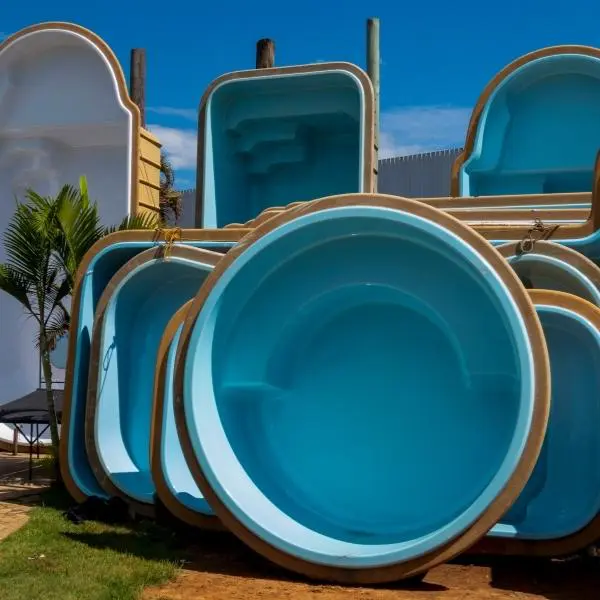
These pools are limited in size due to transport issues (generally max 4.8 m wide x 12 m long).
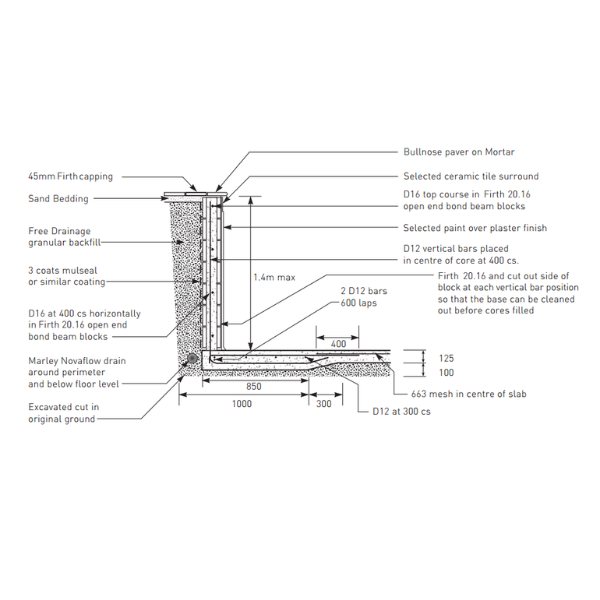
Refer the Firth masonry swimming pool (amended 2016) available on their website (or simply Google it!) This pool is limited in size to 4.0 m wide x 6.4 m long but it is easy to build with a concrete floor, masonry sides and to a maximum depth of 1.3 m water (1.4 m sides).
We have engineered larger pools in masonry but there are a number of limitations including the requirement to use flexible paints over the plaster such as chlorinated rubber paint – or vinyl linings.
A tendency for an increase in popularity due to their low cost. Vinyl lined. Suitable above ground but special measures required inground due to requirements to avoid longer term corrosion.
The following are recommendations regarding pool design and construction:
Pool access is restricted to prevent children from harm. The rules are somewhat complex and it is best to check out the regulations and these regulations have been well summarised in the Auckland Council notes on pool legislation. Access to your pool needs to comply with Government regulations for pool fencing.
On 1 January 2017, the Building (Pools) Amendment Act repealed the Fencing of Swimming Pools Act and inserted new provisions into the Building Act 2004. It requires barriers around pools to restrict unsupervised access by children. Barriers can include gates and suitably constructed fences, walls, and other barriers and compliant doors on house doors.
Proconsult have been engaged with many swimming pool designs through the country. Please contact us today to discuss your requirements.
Stewart is the journal editor for SESOC (Structural Engineering Society New Zealand (Inc.)

I’ll explain in detail what a Certificate of Acceptance (COA) is, who can apply, what the process is, what you need & what happens if you don’t get one

“Unified Peaks” is a landscape-based sculpture created as a collaborative work by Auckland architects, engineers, project mangers and suppliers in New Zealand.

Rule changes for fixing details of handrails and infills to balustrade posts

Everything you need to know about Portal Frames with charts and details to provide a quick reference for architects.

Council requirements for gravity retaining walls, cantilevered retaining walls, sheet piling retaining walls and anchored retaining walls.

Swimming Pool Certification relating to both in-ground and above ground concrete swimming pools and concrete masonry pools.